

Key Insight
Real estate agent fees are paid by whoever agreed in writing to pay them. In most Charlotte and Lake Norman sales the seller still pays the listing side from closing proceeds and may offer compensation toward the buyer's agent. Since August 17, 2024, that buyer side is no longer advertised in the MLS, so buyers now sign their own written agreement and the fee is negotiated openly. Total commission in North Carolina averages about 5.5 percent, but it is a business term, not a fixed
rate.

What you will get in this post
- What agent fees actually mean and where the money goes
- Who pays real estate agent fees in a typical sale
- Your buyer agency agreement is the document that decides
- Realtor fees at closing and what you see on the settlement statement
- How much are realtor fees in 2026 with real local numbers
- The commission split between agents and the brokerage
- Flat fee, discount broker, and FSBO alternatives
- Commission negotiation tips that actually work
- Bonus: the who pays what cheat sheet
1. What agent fees actually mean and where the money goes
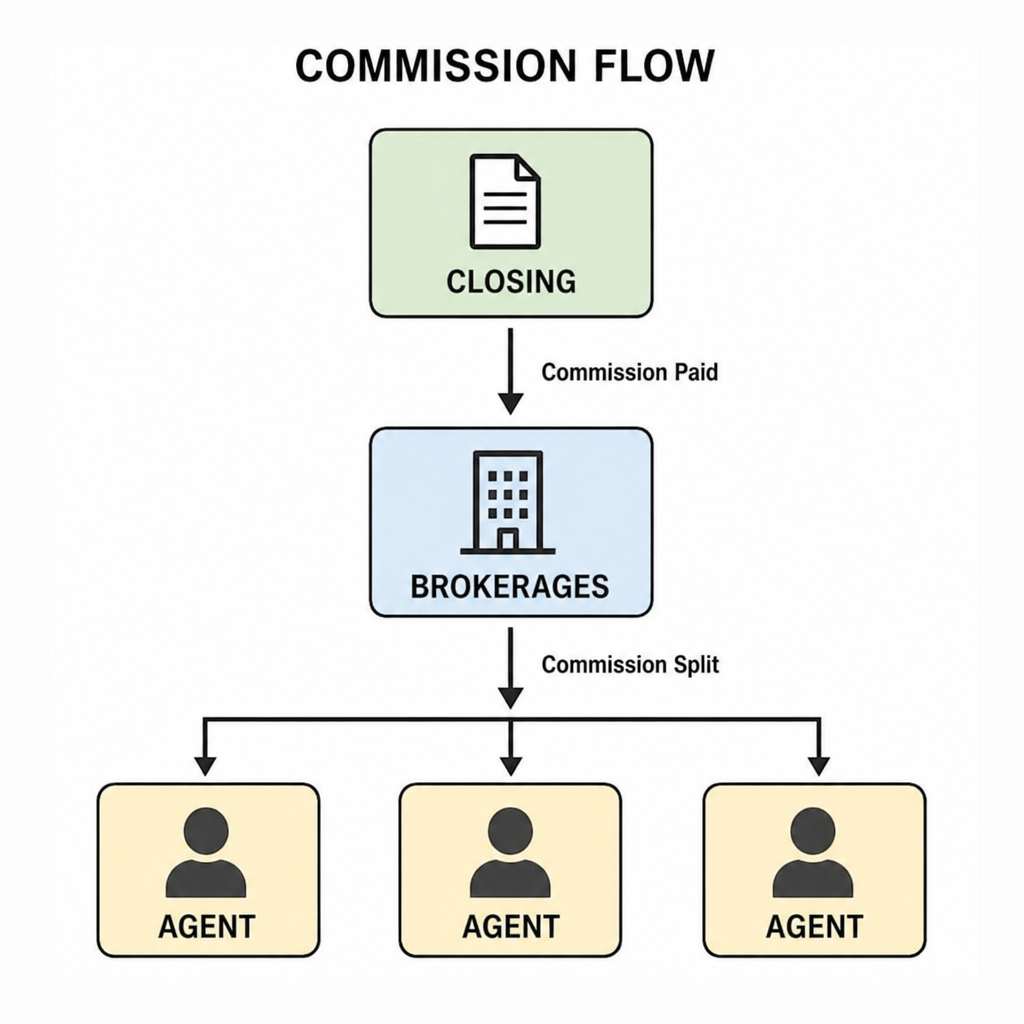
In most traditional transactions the largest real estate agent cost is the broker commission. It is a percentage of the final sale price, not an hourly rate.
That commission is paid to a brokerage first. The brokerage then divides it among the companies and people who worked the deal.
This is the part almost nobody explains clearly. The number on the listing agreement is never what one agent takes home.
How are Realtors paid, step by step
- The listing agreement sets the total. The seller and the listing firm agree in writing on the fee and how it may be shared.
- Closing funds the fee. In most local deals it comes out of seller proceeds at the closing table.
- The brokerage receives the money. In North Carolina commission is deposited with the firm, not the individual agent.
- The firm splits with the agent. That split varies widely by brokerage model and production level.
- The agent covers their own costs. Marketing, MLS dues, insurance, and self-employment taxes come after the split.
Pro Tip
When you compare two agents, do not just compare percentages. Ask each one for a written scope of work. Two identical rates can buy completely different levels of marketing, negotiation, and process management.
2. Who pays real estate agent fees in a typical sale
Traditionally the seller pays commission out of sale proceeds, and the listing firm may offer compensation to the buyer's broker. That is why buyers assumed representation was free.
That assumption no longer holds automatically. The rules changed in August 2024 and the money conversation is now explicit on both sides.
What sellers commonly pay
- The listing side fee agreed in the listing agreement
- Any compensation they choose to offer toward buyer representation
- North Carolina excise tax at two dollars per five hundred dollars of sale price
- Attorney fees, prorated taxes, and any negotiated repair credits
- Optional items like a home warranty or pre-listing improvements
What buyers may now pay
- A buyer agency fee if their signed agreement requires one
- The shortfall if seller-offered compensation does not cover the agreed fee
- A flat fee or percentage stated directly in the buyer agreement
- Nothing at all, if the seller's offered compensation covers the full amount
Who pays the broker fee is not a trivia question. It is a contract question. The paperwork decides it, not local tradition.
Coach Brock Zevan
3. Your buyer agency agreement is the document that decides
North Carolina has been ahead of most states here. Commission Rule 58A .0104(a) has long required agreements for brokerage services to be in writing and signed.
Since the national settlement took effect, buyers working with a Realtor sign that written agreement before touring homes. The fee is on paper before the first showing.
Five clauses to read before you sign anything
- The fee amount. Percentage, flat fee, or hourly, and whether it is a floor or a ceiling.
- When it is owed. At contract signing, at offer acceptance, or only at closing.
- The offset language. Whether you owe anything if the seller covers part or all of it.
- The term and territory. How long it runs and which areas or property types it covers.
- Exclusive or not. North Carolina agents can use an exclusive form, a non-exclusive form, or a single property showing form.
Pro Tip: Ask for the Working With Real Estate Agents disclosure at your first real conversation with any agent. In North Carolina it is required at first substantial contact, and it explains agency in plain language before money is ever discussed.
4. Realtor fees at closing and what you see on the settlement statement
Most people focus on the percentage and forget the mechanics. At closing, agent fees appear as line items that disburse money to brokerages.
Even when the seller pays, the funds come from the transaction itself. That is why fee structure quietly shapes price negotiations.
Four structures you will actually see
- Seller pays both sides. Still the most common structure locally, funded from proceeds.
- Buyer pays their own side. Agreement based, and increasingly common on investor and cash deals.
- Seller concession covers buyer fees. Negotiated into the offer as a credit.
- Split responsibility. Seller covers part, buyer covers the gap.
Key Insight
Total seller closing costs in North Carolina commonly run six to eight percent of sale price when the seller offers buyer-agent compensation, and closer to four to five percent when they do not. Run both scenarios on a net sheet before you pick a strategy.
5. How much are realtor fees in 2026 with real local numbers
There is no official rate. A February 2026 agent survey put the North Carolina average total commission at roughly 5.52 percent, slightly below the national 5.70 percent, with about 2.80 percent on the listing side.
Local price points make that percentage feel very different. Canopy MLS reported a Charlotte region median sales price of 410,000 dollars in May 2026, while the Lake Norman submarket median hit 615,000 dollars in April 2026, up 7.0 percent year over year.
What 5.5 percent looks like in dollars
- 410,000 dollar Charlotte region median. About 22,600 dollars total commission.
- 615,000 dollar Lake Norman median. About 33,900 dollars total, roughly 17,200 dollars on the listing side.
- 995,000 dollar luxury listing. About 54,700 dollars total, which is exactly why luxury sellers negotiate hardest.
- Excise tax adds up too. On a 615,000 dollar sale that is another 2,460 dollars to the state.
- Higher price does not mean higher percentage. Premium properties often carry lower rates because the dollar total is already large.
Pro Tip
Do not shop rate in isolation. On a 615,000 dollar Lake Norman home, a half point of fee savings is about 3,075 dollars. Weak pricing strategy or thin marketing can cost you five times that in a single price reduction.
6. The commission split between agents and the brokerage
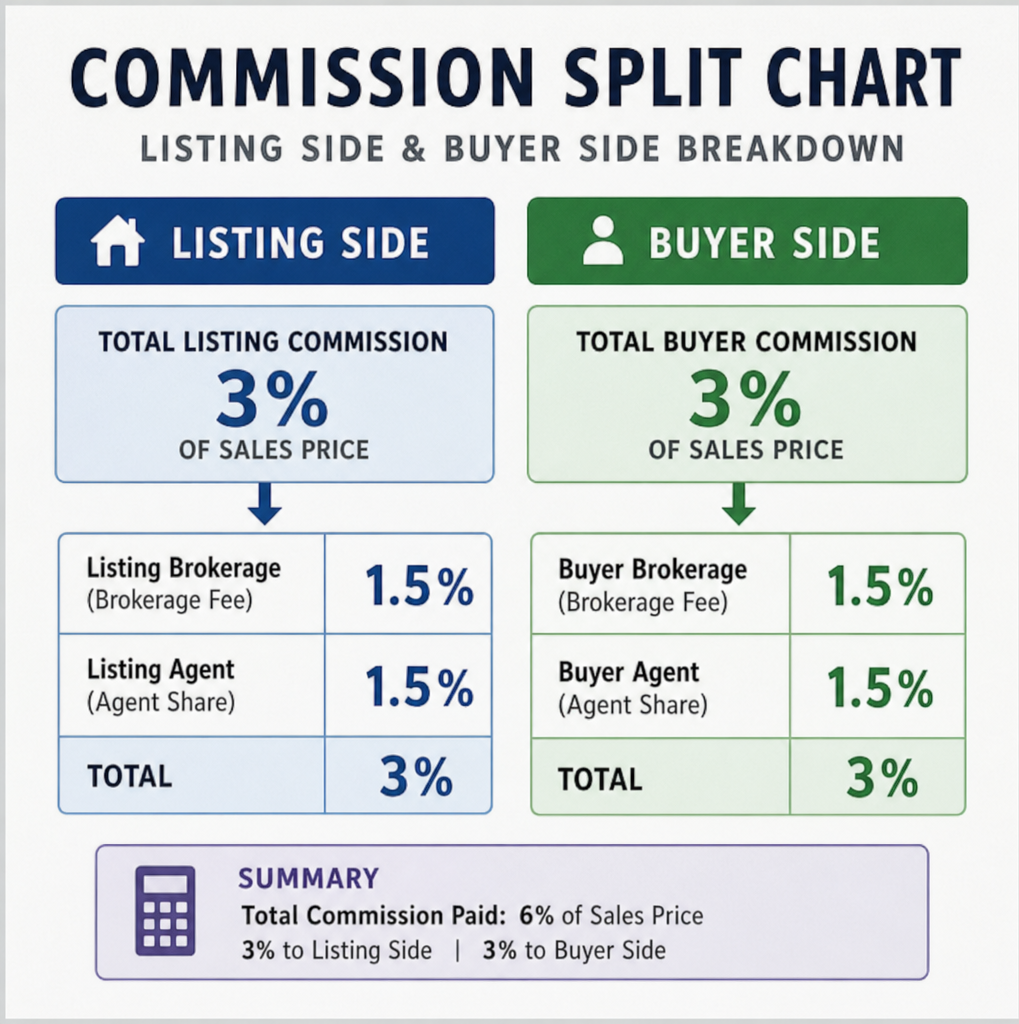
Consumers often assume the agent pockets the whole fee. In reality there are usually two splits stacked on top of each other.
First the total splits between the listing side and the buyer side. Then each side splits again between the firm and the individual agent.
A simplified example on a 615,000 dollar sale
- Total agreed fee. Roughly 33,900 dollars at 5.5 percent.
- Listing side. About 17,200 dollars goes to the listing brokerage.
- Brokerage portion. Firms commonly retain fifteen to thirty percent of that side.
- Agent portion. The remainder, before marketing, MLS dues, insurance, and self-employment taxes.
- Buyer side. The same math repeats at the other brokerage.
This explains why two agents quote different fees. Different brokerage models, overhead, and service packages produce different numbers.
Pro Tip: A rate that is far below market is not automatically a win. Ask what got cut to fund the discount. Photography, video, paid exposure, and negotiation time all cost real money.
7. Flat fee, discount broker, and FSBO alternatives
Traditional commission is not your only option. Each alternative trades cost for work you take on yourself.
Flat fee listing services
- You pay a set price, usually for MLS entry and basic paperwork
- You handle pricing strategy and showing coordination
- You handle offer vetting, counters, and inspection negotiation
- Buyer-side compensation is still a separate decision
- Best fit for experienced sellers with time and a clean property
Discount broker versus full service
- Savings usually come from reduced marketing or fewer included services
- Ask for the scope of work in writing, item by item
- Confirm who attends inspections, appraisals, and closing
- Confirm who negotiates repairs, which is where deals die
- Compare net proceeds, not rate
FSBO versus Realtor commission
For sale by owner sellers try to avoid the listing fee entirely. Many still end up paying buyer-side compensation to attract represented buyers, so zero commission is rarely the real outcome.
Saving two percent on fees and losing five percent on price is not a discount. It is a more expensive sale with a better story attached.
Coach Brock Zevan
8. Commission negotiation tips that actually work
The best negotiators do not open with a lower percentage. They negotiate scope and structure, which is where the real leverage lives.
Five questions to ask every agent
- What is included? Staging advice, professional photos, video, 3D tour, paid ads, print.
- Can we tier the fee? Tie it to sale price achieved or days on market.
- What if I find the buyer? Ask about a reduced listing-only fee.
- Can we structure a bonus? Lower base plus performance upside aligns incentives.
- What is your cancellation policy? Know your exit before you need it.
Practical ways to reduce fees
- Cap or unbundle marketing add-ons instead of paying a blanket rate
- Compare two or three written proposals side by side
- Bundle a sale and a purchase with the same agent
- Buyers: negotiate fee terms before touring, because it is much harder afterward
- Ask for the net sheet, then decide
Key Insight
Fees are negotiable. Signed agreements are binding. Every conversation about money should happen before you sign, not after you are emotionally committed to a house or a timeline.
Bonus: the who pays what cheat sheet
Run these five scenarios before you list or before you tour. Most surprises at closing come from skipping this step.
- Scenario one. Seller pays both sides, funded from proceeds.
- Scenario two. Seller pays listing side only, buyer covers their own agent.
- Scenario three. Seller offers a concession that the buyer applies to their agent fee.
- Scenario four. Flat fee listing plus buyer-side compensation offered separately.
- Scenario five. Cash or as-is sale where fee structure and timeline both shift.
Then layer in closing costs, repair credits, staging, and time on market risk. The lowest fee rarely produces the highest net.
Helpful links from Brock
- Mortgage Calculator (payment math on any price point)
- Affordability Calculator (set your real budget first)
- Free Home Valuation (know your number)
- Seller Game Plan (pricing, prep, and positioning)
- Buyer Game Plan (fee terms handled up front)
- Sell Your Home (full listing process)
- Search Listings (Lake Norman and Charlotte inventory)
- See Recent Sold Homes (real closed comps)
- Preferred Lenders (closing cost estimates)
- Novation and Creative Sale Options (inherited and as-is situations)
- Client Reviews (150 plus Google reviews)
- About Brock the Realtor (background and credentials)
- Coaching with Brock (for agents and teams)
- Book Brock to Speak (events and summits)
- Meet the BZ Three Team (who you actually work with)
- Brock's Books (strategy and mindset)
- Brock's Broadcast (market and mindset episodes)
- Upcoming Events (local and national)
- Community Involvement (local roots)
- More Brock Blogs (market updates and guides)
- Contact Brock (704-345-3400)
Frequently Asked Questions
- Who pays real estate agent fees?
Whoever agreed in writing to pay them. In most Charlotte and Lake Norman sales the seller pays the listing side from proceeds and may offer compensation toward the buyer's agent. - Do buyers pay Realtor fees?
They can. If the seller's offered compensation does not cover the fee in your signed buyer agreement, you owe the difference. - How much are Realtor fees in North Carolina?
A February 2026 agent survey put the state average total commission near 5.52 percent, with roughly 2.80 percent on the listing side. There is no set rate. - What does commission cost on a Lake Norman home?
At the April 2026 Lake Norman median of 615,000 dollars, 5.5 percent total is about 33,900 dollars, with roughly 17,200 dollars on the listing side. - Is real estate commission negotiable?
Yes. Rate, structure, and scope are all negotiable business terms, and they are easiest to negotiate before you sign. - Do I have to sign a buyer agency agreement in North Carolina?
If you want representation, yes. State rules require written agency agreements, and Realtors now require one before showing homes. - Can I tour a home without signing anything?
You can attend an open house or view a listing agent's own home as an unrepresented buyer. Once an agent works for you, the agreement comes first. - What is the Working With Real Estate Agents disclosure?
A required North Carolina form delivered at first substantial contact. It explains seller agent, buyer agent, and dual agent relationships. - Are buyer agent fees still advertised in the MLS?
No. Since August 17, 2024, buyer-agent compensation is no longer published through the MLS, so it is negotiated directly. - Can a seller still pay my buyer agent?
Yes. Sellers routinely offer compensation or a concession that covers buyer-side fees. It just has to be negotiated in the deal. - How is commission split between agents?
The total splits between listing side and buyer side, then each side splits again between the brokerage and the agent. - Does the agent keep the whole commission?
No. In North Carolina the fee is deposited with the firm, which retains a portion before paying the agent. - Is a flat fee listing cheaper overall?
Sometimes. You save on listing fee and take on pricing, showings, and negotiation yourself. Compare net proceeds, not rate. - Do FSBO sellers avoid commission entirely?
Rarely. Most still offer buyer-side compensation to attract represented buyers. - What are total seller closing costs in North Carolina?
Commonly six to eight percent of sale price when offering buyer-agent compensation, or four to five percent when not, including excise tax and attorney fees. - What is North Carolina excise tax on a home sale?
Two dollars per five hundred dollars of sale price. On a 615,000 dollar sale that is 2,460 dollars. - How do I find out exactly what I will net?
Run the net sheet calculator, then call Brock at 704-345-3400 and walk through your actual scenario.
What Clients Are Saying
Real results from real people working with Coach Brock.
★★★★★
“Brock made our property search a great experience. He was responsive, patient, and helped us find a home that matched what we were looking for.”
Daniel Foster | Mooresville, NC - Buyer
★★★★★
“Brock was professional and knowledgeable throughout the sale of our home. He communicated clearly and kept us updated at every step.”
Megan Taylor | Davidson, NC - Seller
★★★★★
“Brock was very helpful from our first meeting through closing. He listened to our needs and made the home-buying process easy to follow.”
Ryan Cooper | Charlotte, NC - Buyer
Final thought
Fees are negotiable, but signed agreements are binding. Get the numbers on paper before you are under pressure, and you will never be surprised at the closing table. Call Brock at 704-345-3400 and let us run your real scenario.
Brock Zevan, Broker, Real Brokerage LLC. North Carolina License #256028. Serving Cornelius, Davidson, Huntersville, Mooresville, Concord, and the greater Charlotte metro. This content is general education, not legal, tax, or financial advice. Commission rates and fee structures are set by individual agreements and are fully negotiable. Market figures referenced from Canopy MLS April and May 2026 reports and a February 2026 national agent commission survey, and may change without notice. Verify all agreement terms with your broker and attorney before signing. Equal Housing Opportunity.
FROM OUR BLOG


Is North Carolina Expensive to Live In? A Lake Norman Cost of Living Reality Check
Market Guide Is North Carolina Expensive to Live In? A Lake Norman Cost of Living Reality Check Most people search Google or ChatGPT for a statewide number. That number will not tell you what a home in Cornelius, Davidson, Huntersville, or Mooresville actually costs you every month. Here is the real

What Should You Know Before Buying Land in Western NC?
Buying Strategy What Should You Know Before Buying Land in Western NC? Mountain land sells the view. It does not sell the septic permit, the road agreement, or the tax bill that follows you to closing. Here is the due diligence that separates a smart buy from an expensive lesson. Brock Zevan·Real Br

Wilmington NC Commercial Real Estate: What Lake Norman Owners Need to Know Before Buying on the Coast
Commercial Real Estate Wilmington NC Commercial Real Estate: What Lake Norman Owners Need to Know Before Buying on the Coast Wilmington keeps landing on investor shortlists, and the 2026 numbers explain why. This guide covers the property types, the live vacancy and cap rate data, and the coastal ru